The Night Nobody Noticed Is the Night This Exists to Prevent.
Chapters already run a safety system — sashes, wristbands, a shared phone number, a GroupMe thread. It just depends on memory, signal, and spotting the right person in a dark, loud room. This gives that system a record, a live queue, and a way to reach someone in the ten minutes that actually matter.
Built on the Active SOS platform — your chapter's own roster, sober monitors, and events.
She's covered from the front porch to the last call home.
Every check-in and alert reaches your house mom and the sober monitor on duty in real time — not a report pulled the next morning. It's a visible, standing proof point that your chapter takes her safety seriously, every single event.
See How It Works ↓The Numbers Behind It
This Isn't a Hypothetical Risk Category.
A defined, countable market with a real, peer-reviewed prevalence number behind the core risk — not just news stories and anecdotes.
Neither Story Is About a Chapter That Didn't Care
Both Are About a Safety System That Ran on Memory.
Real, current, sourced incidents — not hypotheticals. Informal structures that don't hold up on the one night, or the one pledge season, they're actually tested.
Dartmouth, July 2024 — "the night nobody noticed"
A 20-year-old Dartmouth student drowned in the Connecticut River after a joint social hosted by a sorority and a fraternity. His blood alcohol was more than twice the legal limit. The detail that matters most isn't the drinking — it's that no one at the event noticed he was missing until he was found the next day. Both organizations were suspended; the sorority remains under conduct sanctions through 2026.
Sources: NPR, The Dartmouth, NHPR — reported Nov 2024–Feb 2025Austin, early 2025 — the pledge-season blind spot
A University of Texas fraternity pledge died by suicide after weeks of hazing during pledge season — forced drinking, physical abuse, and humiliation. His national organization closed the chapter in May 2025. The people closest to him saw pieces of what was happening; there was no system for any one of them to flag it before it became irreversible.
Different failure, same root cause: no channel to report in the moment.Real safety doesn't require watching someone every second.
It requires being reachable in the ten minutes that actually matter.
The Pain Point, On Each Side of the House
Different Letters. Same Broken System.
The Sober Monitor Problem
Chapters already assign sober monitors every social — sashes, wristbands, a phone number shared in a group chat. It's a real system; it just depends on someone remembering who's on duty and spotting the right sash in a dark, loud room. Rush season compounds it: more than half of college sexual assaults happen August–November, and about 1 in 13 students report being drugged at least once.
The Pledge-Season and Party Blind Spot
FIPG's Risk Management Policy already obligates every member to report incidents that could become an insurance claim or hit the news. In practice, there's no channel to do that in the moment — especially during pledge events, where the newest members are least likely to speak up. Alcohol is involved in 69% of hazing deaths; the average victim is 19.
What It Does
Three Things. Not Ten.
The same real-time triage model already running Active SOS's other safety platforms — built for the screen that's open during the event, not a report pulled the next morning.
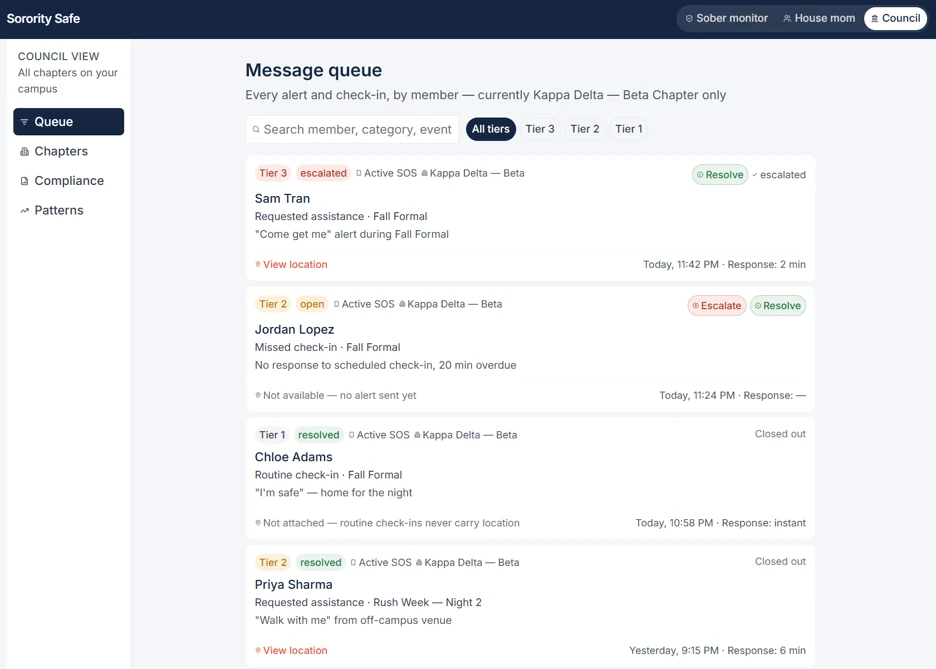
A Live Queue Someone Is Actually Watching
Every check-in and alert lands in one triaged feed — tier, status, response time. House moms, risk managers, and on-duty monitors see it the moment it happens, not the next morning.
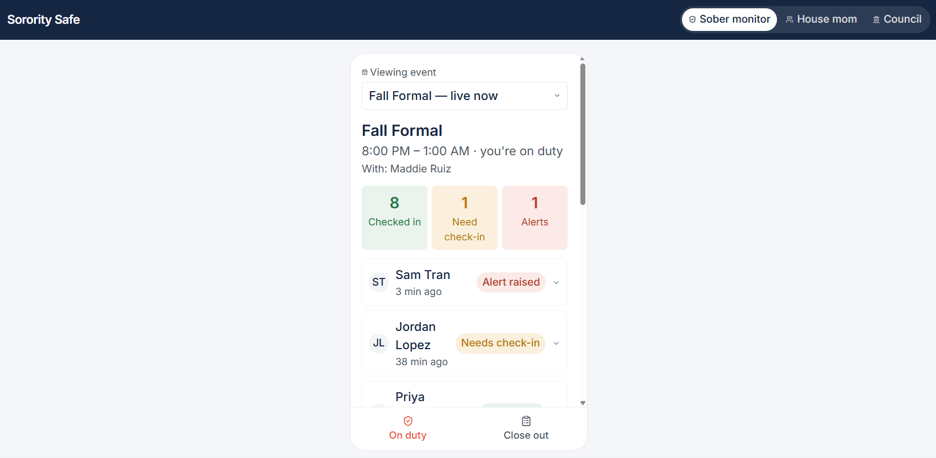
The On-Duty Role, Finally Digitized
Sober monitors and risk managers already get assigned every event. This gives that assignment an actual system: who's on duty, who's checked in, and a one-tap way to call, text, or locate a member who shared her location with an alert.
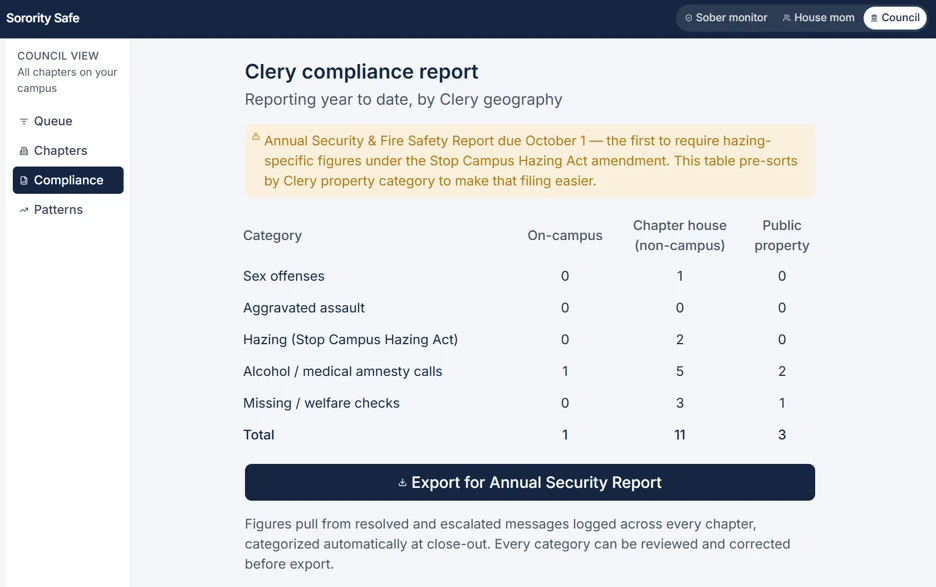
Built for the Compliance Obligation That Already Exists
Every alert and event is tagged by Clery Act geography — on-campus, chapter house, or public property. Federal law already requires this data; this just makes it easy to have on hand.
For House Moms, Risk Managers & Chapter Advisors
Why This Matters for Compliance, Specifically
FIPG's Risk Management Policy — adopted by nearly every national fraternity and most national sororities — already requires members to promptly report incidents that could become an insurance claim or hit the news. Today that duty runs through GroupMe and word of mouth. This gives it a record.
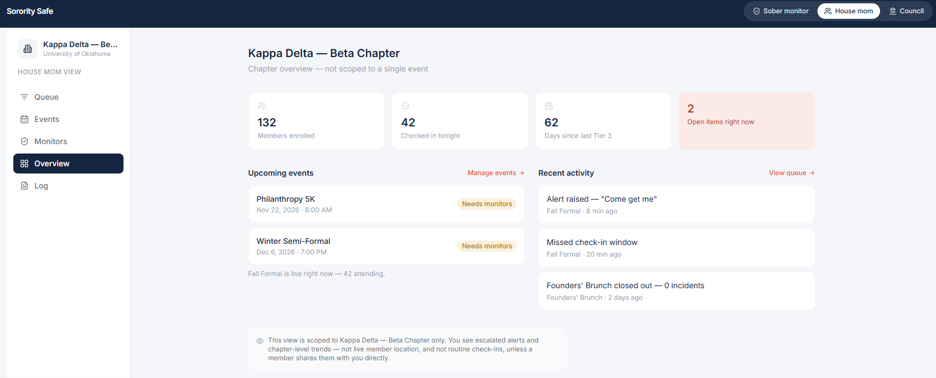
- Institutions must collect hazing incident data starting Jan 1, 2025, included in the Annual Security Report due Oct 1, 2026.
- Schools must publish a public Campus Hazing Transparency Report at least twice a year, naming any organization found responsible.
- Every event closeout — attendance, incidents, notes — ties directly to its Clery geography: on-campus, chapter house, or public property.
- Sober monitors and on-duty members close out an event in under 30 seconds; the record already exists by the time anyone asks for it.
Get the App
Every Student Already Has a Phone. That's the Only Device This Needs.
Sorority Safe and Fraternity Safe run on Active SOS — one app, one button. No extra hardware, no new login for members to remember, no learning curve during the week that matters most.
Half off the annual plan for chapters and members who sign up with your organization code.
Bring This to Your Chapter, Council, or Campus.
For risk managers, house moms, chapter advisors, and Panhellenic/IFC leadership evaluating this for rush, formals, or the season ahead. Let's find 15 minutes to talk about it.